Pennylane
2026
B2B App
•
Case Study
Pennylane brings together SME leaders and their accountants around one tool, built for everyone from freelancers to larger SMEs, without trading off simplicity or power. A specific need follows: when an employee covers an expense with a personal card, the process stays manual — receipts, photos, emails — prone to oversights, delays, and a tracking burden shared by both sides.
How to simplify expense reports, from spending to reimbursement?
Pennylane
2026
B2B App
•
Case Study
Pennylane brings together SME leaders and their accountants around one tool, built for everyone from freelancers to larger SMEs, without trading off simplicity or power. A specific need follows: when an employee covers an expense with a personal card, the process stays manual — receipts, photos, emails — prone to oversights, delays, and a tracking burden shared by both sides.
How to simplify expense reports, from spending to reimbursement?
Pennylane
2026
B2B App
•
Case Study
Pennylane brings together SME leaders and their accountants around one tool, built for everyone from freelancers to larger SMEs, without trading off simplicity or power. A specific need follows: when an employee covers an expense with a personal card, the process stays manual — receipts, photos, emails — prone to oversights, delays, and a tracking burden shared by both sides.
How to simplify expense reports, from spending to reimbursement?

PROJECT DETAILS
Industry
Fintech
Time
Two weeks
Location
The Design Crew Bootcamp - Paris, FR
Process
Discovery to Delivery
Understanding the flow before asking questions
Understanding the existing process in detail was therefore the necessary starting point — its steps, the stakeholders involved at each stage (manager, finance lead, accounting), what each one checks or approves, and why.
Since Pennylane serves TPEs and SMEs first and foremost, but also mid-sized companies (ETI) per its own positioning, this mapping had to account for companies of different sizes — to surface potential issues at each step, regardless of company profile. This groundwork then fed into building the research objectives and the questions asked in user interviews.
Understanding the flow before asking questions
Understanding the existing process in detail was therefore the necessary starting point — its steps, the stakeholders involved at each stage (manager, finance lead, accounting), what each one checks or approves, and why.
Since Pennylane serves TPEs and SMEs first and foremost, but also mid-sized companies (ETI) per its own positioning, this mapping had to account for companies of different sizes — to surface potential issues at each step, regardless of company profile. This groundwork then fed into building the research objectives and the questions asked in user interviews.
Understanding the flow before asking questions
Understanding the existing process in detail was therefore the necessary starting point — its steps, the stakeholders involved at each stage (manager, finance lead, accounting), what each one checks or approves, and why.
Since Pennylane serves TPEs and SMEs first and foremost, but also mid-sized companies (ETI) per its own positioning, this mapping had to account for companies of different sizes — to surface potential issues at each step, regardless of company profile. This groundwork then fed into building the research objectives and the questions asked in user interviews.


Theory meets the field
Some hypotheses hold up: a lack of clarity around expense policy does affect three out of five employees, with rules often communicated verbally rather than in writing.
Other realities weren't anticipated. Filing varies widely between companies — per expense, per monthly bundle, per trip, sometimes gated by a minimum amount. Only photographing the receipt stays constant, whatever the format. Turning to spreadsheet software isn't a systematic choice: for some, it's a makeshift fix for a poorly defined process.
Finally, asked to choose between speed and visibility, most picked visibility — a sign that this frustration feels easier to fix than approval delays. As for the full automation everyone mentioned, it's more an ideal than a reachable target, but one worth keeping in mind.
Theory meets the field
Some hypotheses hold up: a lack of clarity around expense policy does affect three out of five employees, with rules often communicated verbally rather than in writing.
Other realities weren't anticipated. Filing varies widely between companies — per expense, per monthly bundle, per trip, sometimes gated by a minimum amount. Only photographing the receipt stays constant, whatever the format. Turning to spreadsheet software isn't a systematic choice: for some, it's a makeshift fix for a poorly defined process.
Finally, asked to choose between speed and visibility, most picked visibility — a sign that this frustration feels easier to fix than approval delays. As for the full automation everyone mentioned, it's more an ideal than a reachable target, but one worth keeping in mind.
Theory meets the field
Some hypotheses hold up: a lack of clarity around expense policy does affect three out of five employees, with rules often communicated verbally rather than in writing.
Other realities weren't anticipated. Filing varies widely between companies — per expense, per monthly bundle, per trip, sometimes gated by a minimum amount. Only photographing the receipt stays constant, whatever the format. Turning to spreadsheet software isn't a systematic choice: for some, it's a makeshift fix for a poorly defined process.
Finally, asked to choose between speed and visibility, most picked visibility — a sign that this frustration feels easier to fix than approval delays. As for the full automation everyone mentioned, it's more an ideal than a reachable target, but one worth keeping in mind.

From research to design
This new problem statement stems from the learnings, needs, and frictions gathered during the interviews. It stays true to the original problem, covering the full expense report process, while placing emphasis on adapting to the diversity of companies Pennylane serves.
How can the expense report process be made transparent and its actions centralized, while adapting to any company's reimbursement workflow?
To define which components to bring into the existing app, a benchmark was run across fintech applications, ranging from expense management tools to online banks. It looked at entry forms, intelligent receipt scanning, reimbursement progress tracking, and cap consultation with expense grouping, to see how each feature translated into interface, concretely.
With part of Pennylane's design system made available, new components were built by drawing on it as much as possible, for a consistent fit within the current mockups.
From research to design
This new problem statement stems from the learnings, needs, and frictions gathered during the interviews. It stays true to the original problem, covering the full expense report process, while placing emphasis on adapting to the diversity of companies Pennylane serves.
How can the expense report process be made transparent and its actions centralized, while adapting to any company's reimbursement workflow?
To define which components to bring into the existing app, a benchmark was run across fintech applications, ranging from expense management tools to online banks. It looked at entry forms, intelligent receipt scanning, reimbursement progress tracking, and cap consultation with expense grouping, to see how each feature translated into interface, concretely.
With part of Pennylane's design system made available, new components were built by drawing on it as much as possible, for a consistent fit within the current mockups.
From research to design
This new problem statement stems from the learnings, needs, and frictions gathered during the interviews. It stays true to the original problem, covering the full expense report process, while placing emphasis on adapting to the diversity of companies Pennylane serves.
How can the expense report process be made transparent and its actions centralized, while adapting to any company's reimbursement workflow?
To define which components to bring into the existing app, a benchmark was run across fintech applications, ranging from expense management tools to online banks. It looked at entry forms, intelligent receipt scanning, reimbursement progress tracking, and cap consultation with expense grouping, to see how each feature translated into interface, concretely.
With part of Pennylane's design system made available, new components were built by drawing on it as much as possible, for a consistent fit within the current mockups.

Understood in use, lost in words
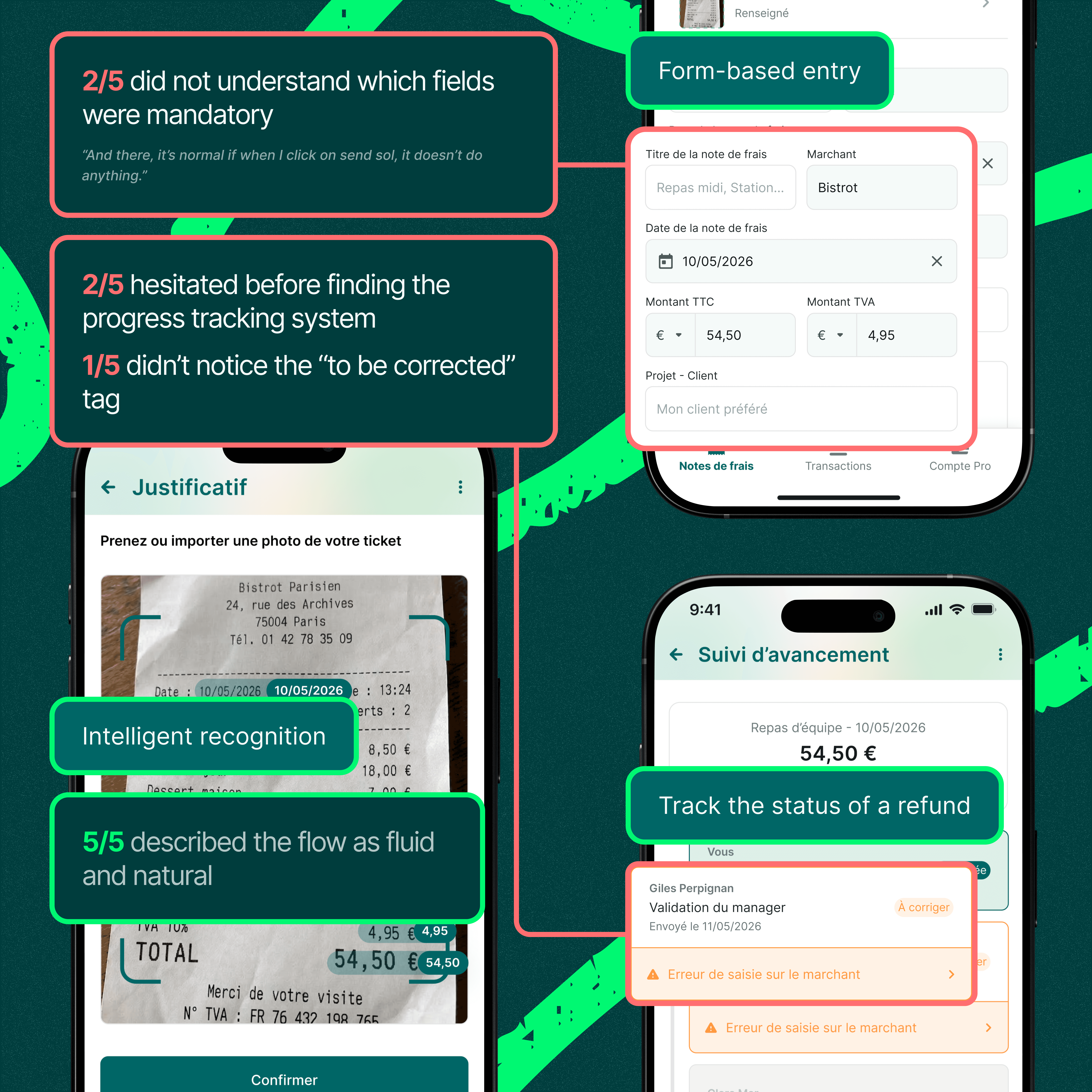
The tests confirmed the relevance of the core structural choices: filing an expense, grouping claims into a folder, and reaching out to the approver were all understood and used without difficulty by nearly every participant.
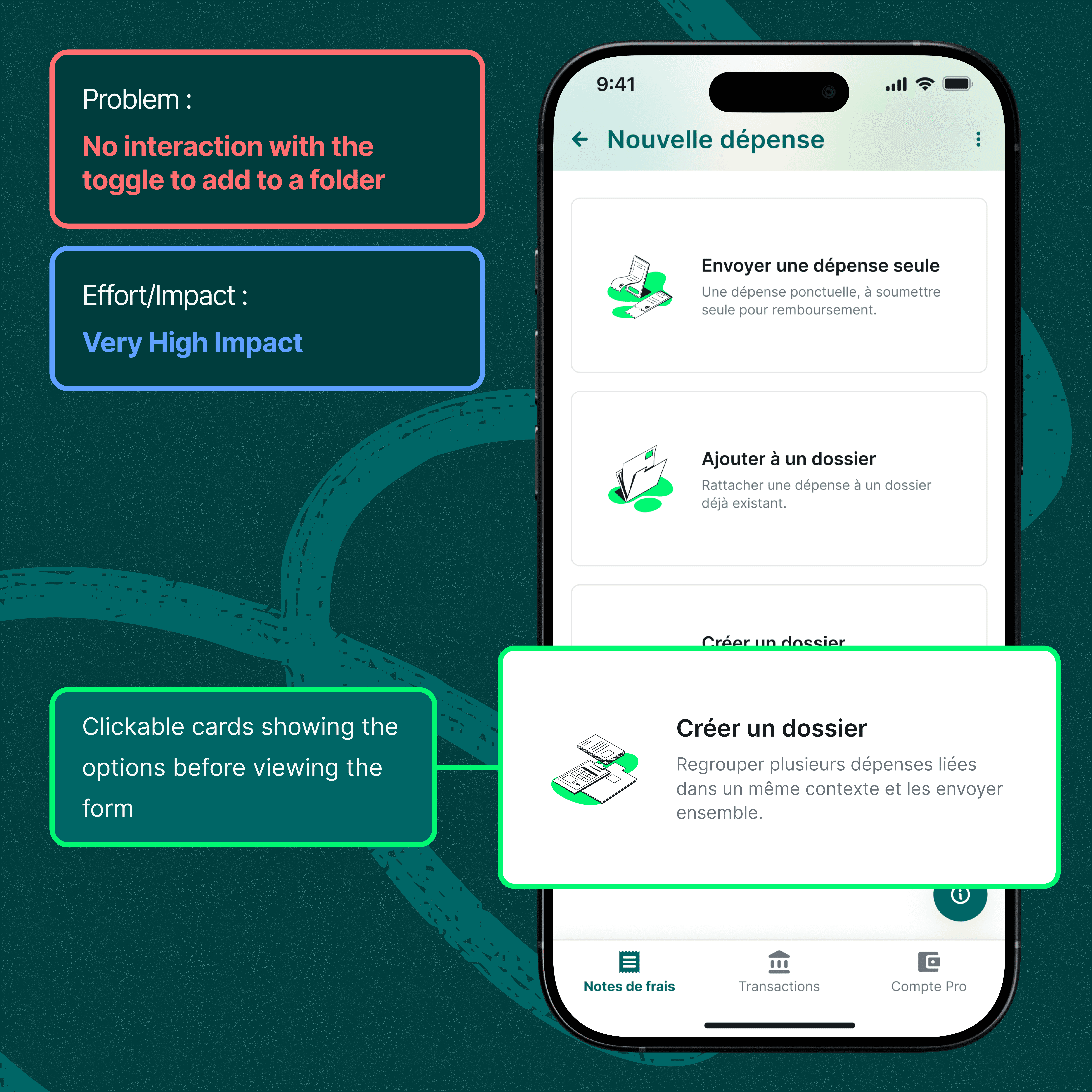
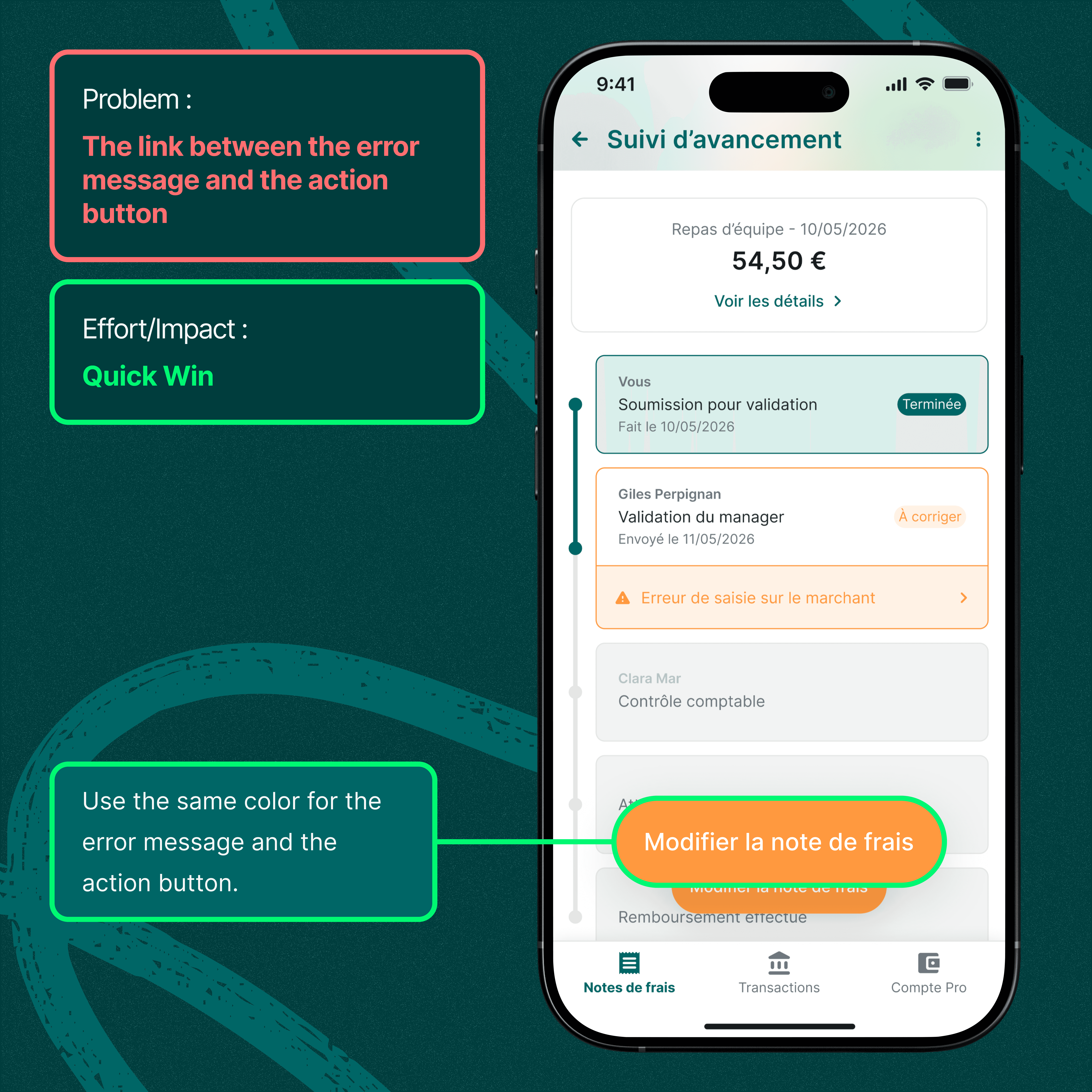
Friction concentrated mostly on wording and the visibility of certain elements. The label "Règlement" for the expense policy section wasn't understood by the majority, leading some to create a fake expense just to check a spending cap. Likewise, the toggle for placing a claim into a folder, and the tag flagging a correction to make, went unnoticed for some testers.

Understood in use, lost in words
The tests confirmed the relevance of the core structural choices: filing an expense, grouping claims into a folder, and reaching out to the approver were all understood and used without difficulty by nearly every participant.
Friction concentrated mostly on wording and the visibility of certain elements. The label "Règlement" for the expense policy section wasn't understood by the majority, leading some to create a fake expense just to check a spending cap. Likewise, the toggle for placing a claim into a folder, and the tag flagging a correction to make, went unnoticed for some testers.
Understood in use, lost in words
The tests confirmed the relevance of the core structural choices: filing an expense, grouping claims into a folder, and reaching out to the approver were all understood and used without difficulty by nearly every participant.
Friction concentrated mostly on wording and the visibility of certain elements. The label "Règlement" for the expense policy section wasn't understood by the majority, leading some to create a fake expense just to check a spending cap. Likewise, the toggle for placing a claim into a folder, and the tag flagging a correction to make, went unnoticed for some testers.

Effort, impact, decision
Test observations were plotted on an effort/impact matrix to decide what to build first. Some fixes, high-impact and easy to implement, became immediate quick wins. Others required more time and effort, but given the friction observed, their potential impact justified tackling them anyway.
Four areas were prioritized as a result: filing an expense, grouping multiple expenses together, consulting the expense policy, and handling an error that needs correcting.
Effort, impact, decision
Test observations were plotted on an effort/impact matrix to decide what to build first. Some fixes, high-impact and easy to implement, became immediate quick wins. Others required more time and effort, but given the friction observed, their potential impact justified tackling them anyway.
Four areas were prioritized as a result: filing an expense, grouping multiple expenses together, consulting the expense policy, and handling an error that needs correcting.
Effort, impact, decision
Test observations were plotted on an effort/impact matrix to decide what to build first. Some fixes, high-impact and easy to implement, became immediate quick wins. Others required more time and effort, but given the friction observed, their potential impact justified tackling them anyway.
Four areas were prioritized as a result: filing an expense, grouping multiple expenses together, consulting the expense policy, and handling an error that needs correcting.

Behind the employee journey, the rules of the game
The tested journeys focused solely on the employee experience. But simplifying the expense report process also involves managers and accountants, who define the rules applied upstream. Each company can therefore configure its own expense charter directly within the app — caps, deadlines, allowed expense types — along with which fields to make mandatory during filing, such as merchant name, project, or client.
Behind the employee journey, the rules of the game
The tested journeys focused solely on the employee experience. But simplifying the expense report process also involves managers and accountants, who define the rules applied upstream. Each company can therefore configure its own expense charter directly within the app — caps, deadlines, allowed expense types — along with which fields to make mandatory during filing, such as merchant name, project, or client.
Behind the employee journey, the rules of the game
The tested journeys focused solely on the employee experience. But simplifying the expense report process also involves managers and accountants, who define the rules applied upstream. Each company can therefore configure its own expense charter directly within the app — caps, deadlines, allowed expense types — along with which fields to make mandatory during filing, such as merchant name, project, or client.

What the employee can now do
By the end of this project, an employee knows where to find their company's expense policy, can scan a receipt in one gesture, track their claim's progress through to reimbursement, fix a flagged error without confusion, and follow up with the right person without having to search for them.
What the employee can now do
By the end of this project, an employee knows where to find their company's expense policy, can scan a receipt in one gesture, track their claim's progress through to reimbursement, fix a flagged error without confusion, and follow up with the right person without having to search for them.
What the employee can now do
By the end of this project, an employee knows where to find their company's expense policy, can scan a receipt in one gesture, track their claim's progress through to reimbursement, fix a flagged error without confusion, and follow up with the right person without having to search for them.